What keeps a train on the track?
BoreMeScience1 HN recommenders · 2019–2022
191K views · explainer · evergreen · Uploaded 2009-09-22
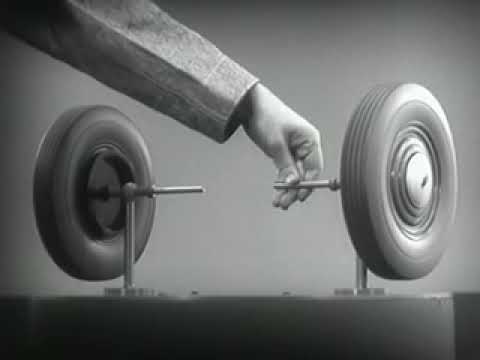
A short clip of Richard Feynman explaining how a train stays on its tracks, through the conical shape of wheels and how it handles curves without differentials.
HN links it as a great, surprising explanation whenever rail wheels, gauge or curves come up.
 9:31
Around The Corner - How Differential Steering Works (1937)
US Auto Industry
 54:37
How Self-Driving Cars will Destroy Cities (and what to do about it)
Not Just Bikes
 32:35
Detergent packs are kinda wishy-washy (Dishwashers Explained)
Technology Connections
 41:53
Mechanical Computer (All Parts) - Basic Mechanisms In Fire Control Computers
Excelsior10000
 18:28
The Antique Toaster that's Better than Yours
Technology Connections
 18:14
Stroads are Ugly, Expensive, and Dangerous (and they're everywhere) [ST05]
Not Just Bikes
 19:43
U.S. NAVY BASIC MECHANISMS OF FIRE CONTROL COMPUTERS MECHANICAL COMPUTER INSTRUCTIONAL FILM 27794
PeriscopeFilm
 11:39
The Ingenious Design of the Aluminum Beverage Can
engineerguy
3 comments from Hacker News
Snopes rates it as partly true, and the author is a pedantic killjoy. It is broadly true that for 2000 years European vehicles matched their roads and adapting existing vehicles to new technology led to using axles that were the same size. Do other gauges exist? Of course. Are the true elements of this worth repeating? Sure. As an unrelated aside here’s Richard Feynman explaining why train axles don’t need differentials. [VIDEO]
> unlike the cylindrical profile which again just steers with the flange basically rubbing against the edge of the railhead. That's crazy. That means that the wheels are actually slipping when going around a corner, because the wheels are all the same diameter. Unlike conical wheels, which are essentially self-steering. Here's a great explanation by Richard Feynman: [VIDEO] How could the BART trains possibly have cylindrical wheels? Conical wheels have been used on trains for ages, so that's seems weird. But doing some research, it seems that, yes, they were cylindrical: > Queensland Railways, for its first hundred years, used cylindrical wheels and vertical rails. With non-inclined rails and cylindrical wheels, the wheel squeal from trains taking curves on that railway was slight. After adopting coned wheels and inclined rails from the mid 1980s, the wheel squeal from trains curving at the same location and at the same speed decreased immensely. Some modern systems, such as Bay Area Rapid Transit (BART) in San Francisco, use cylindrical wheels and flat-topped rails; BART is now switching to conical tread to reduce the noise caused by flange/rail contact and loss of adhesion of one of the wheels on curves. -- [LINK]
[VIDEO] (video of Feynman explaining how trains stay on the track) Is this it? I found it in my YouTube history. Or this one, which superimposes free body diagram (of forces) on the wheels to show how it is self stabilizing? [LINK]