U.S. NAVY BASIC MECHANISMS OF FIRE CONTROL COMPUTERS MECHANICAL COMPUTER INSTRUCTIONAL FILM 27794
PeriscopeFilm11 HN recommenders · 2018–2026
225K views · tutorial · evergreen · Uploaded 2018-05-10
A 1953 US Navy training film on the basic mechanisms in fire control computers: shafts, gears, cams and differentials. It shows how these mechanical parts compute ship and target firing solutions.
HN treats it as the classic demonstration of how analog mechanical computation works, especially the differential gear section.
 28:03
AT&T Archives: Similiarities of Wave Behavior (Bonus Edition)
AT&T Tech Channel
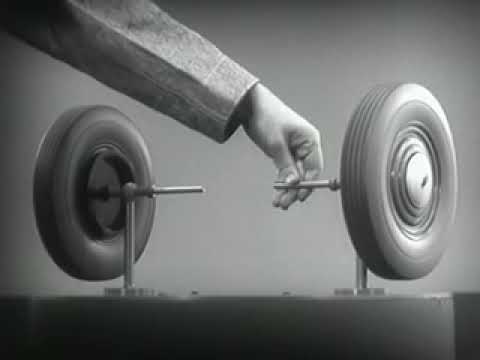 9:31
Around The Corner - How Differential Steering Works (1937)
US Auto Industry
 1:24:13
Micro Men - 720p (2009)
gimpymoo
 1:21:22
Light Years Ahead | The 1969 Apollo Guidance Computer
TNMoC
 32:35
Detergent packs are kinda wishy-washy (Dishwashers Explained)
Technology Connections
 41:53
Mechanical Computer (All Parts) - Basic Mechanisms In Fire Control Computers
Excelsior10000
 56:09
Project Code Rush - The Beginnings of Netscape / Mozilla Documentary
The Documentary Network
 32:56
Bret Victor The Future of Programming
Joey Reid
17 comments from Hacker News
You might like this video about the US Navy fire control computer. Mechanical yet also programmable. Eg with cam-based calculation modules like 1/x or differential gearings to perform addition : [VIDEO]
[LINK] has many examples. For example, mechanical computers used to be used for fire control on naval vessels: [VIDEO]
If you want more information on how you can do computation with mechanical systems, try this video: U.S. NAVY BASIC MECHANISMS OF FIRE CONTROL COMPUTERS MECHANICAL COMPUTER INSTRUCTIONAL FILM 27794 [VIDEO]
This could use a lot more visual aids. Here's a film that goes over a lot of the basics: "BASIC MECHANISMS IN FIRE CONTROL COMPUTERS" [1]. It's a 1953 US Navy instructional film explaining how mechanical fire control computers worked. These machines took inputs giving the speed and direction the ship was traveling, the speed and direction the target was moving, the distance and direction to the target, the wind speed and direction, and other factors, and computed how to aim the guns to shell the target. [1] [VIDEO]
I went a bit further back when I saw "mechanical programming" and thought of this video. [VIDEO] Mechanical analog computing FTW!
If you enjoy this, don't miss the video lecture on World War 2-era mechanical fire control computers by the U.S. Navy. I learned you can do a lot of computations with gears and shafts. [VIDEO]
Antikythera mechanism was built before the Dark Ages, he just wanted to go back to the Dark Ages so he can do precision work by that time, he can probably build a battleship fire control system at that time. edit: [VIDEO]
A special–purpose computer is any device which computes an answer to a specific question given some input or initial conditions. An abacus or slide rule is not a computer because they are not designed for a specific question or problem (but they can of course be an aid to computation). With the Antikythera mechanism, the operator sets the machine to the current date, and then turns the crank to advance the date. The dials on the face would continuously show the positions of several planets, the phase of the moon, the eclipses, and possibly one or two other things. Charles Babbage’s Difference Engine computed the values of polynomials. The operator would set the coefficients of the polynomial, then turn the crank to compute successive values of that polynomial for successive values of X. He never finished it though. The firing computer on a WWII destroyer computed the correct elevation of the guns, based on inputs that encoded the position and velocity of the ship, the position and velocity of the target, and several other variables. [VIDEO] General–purpose computers take as input a _program_, and the program specifies the problem to be solved. You could load a program for computing eclipses one minute, and the next minute load a program for computing polynomials or firing solutions, or load one to check your email. The hardware hasn’t changed, only the program and inputs have changed. Contrast that with the Difference Engine: to make the difference engine compute eclipses or
So I've known about slide-rules for a while. What I didn't realize was that the mechanical principles of slide-rules were applied to fire-control computers on WW2-era Battleships. [LINK] These computers had slide-rule like cylinders that would rotate. As you aimed the gun sights "at" a target, the gun's coordinates were being mapped to a cylinder, which would move the gun a different direction (you have to aim the gun "higher" the further away the target is, to account for gravity "drooping" the bullet). In effect; the weirdly shaped cylinder inside the fire-control computer is a pre-computed solution that maps x/y coordinate inputs to a z-coordinate output (where "z" would be fed into the gun's raw aiming system). The different parameters of the gun were programmed in with gears and cranks, moving the cylinder around physically. For more details, see: [VIDEO] Its a 20-minute video. The cylinder mechanism (of 2x inputs mapped to 1x output) is specifically talked about here: [VIDEO] . Carefully crafted cylinders could be any pre-computed 2-input / 1-output function. --------- Mechanical computers are fun. Slide rules are but the simplest kind. People were using more complicated "mechanical computers" for very serious combat / rangefinding / etc. systems just a few decades ago, before the advent of modern digital computers.
The US Navy had this great video on principles of mechanical computers. Using cams and gears to compute functions. [VIDEO]
There’s just something fun about having your bubble burst. I think most people (including me) think the tech was too primitive. This is what I think computers were then [1] Ultimately, I think bad ass people banded together and worked their butt off to pull off a stretch goal. I wonder if I romanticize engineers from then or there are similar folks today. [1] [VIDEO]
You've probably already seen it, but there's a classic US Navy training film which talks about how they were used to solve differential equations in battleships around the WWII era. [VIDEO]
Two gems (among many)... Periscope Films (on YouTube): [LINK] Digitized 40-60s era reels. It still amazes me how effectively they presented complex topics then. E.g. mechanical naval gunnery computers: [VIDEO] And this on-the-ground movie on the Columbia student occupation in 1968: [LINK]
From top of head I really enjoy: MAPMAKING PROCESS, THE [LINK] mechanism computer of fire control computer (a classic) [VIDEO] Physical science documentary series whose exact title I can't recall. It has been a while. To find more, my method is to do the occasional PeriscopeFilm binge (on youtube that digitizes a lot of old media, with great descriptions), always find find something interesting I haven't watched. If style, delivery really good, there's usually something in description to point to more. Like "U.S. NAVY TRAINING FILM", which usually returns playlists, and videos in same era often share quality. The technical ones generally don't disappoint. Another one is The Best Film Archives with good military training playlists. Tangent for others: the one I wish to remember, is a deleted/banned channel, one of the original US archival footage channel, with I think 1000s of videos, that got wiped many years ago right when youtube started drm crackdown. It had a companion website with obsessive amount of detail and tags to find the perfect video. And from what I recall, it didn't feel like a business like periscopefilm, but a passion project. It was an incredible amount of work to have been wiped out.
I especially like the section on differential gears, demonstrating their use as computing units: (timestamped link) [VIDEO]
I love this unique insight: "Fire control computers ... solve ... fire control problems." [VIDEO] U.S. NAVY BASIC MECHANISMS OF FIRE CONTROL COMPUTERS MECHANICAL COMPUTER INSTRUCTIONAL FILM 27794
There are some old training videos that show how this worked: [VIDEO] Also the Battleship New Jersey YouTube channel has some nice content on this: [LINK]