Jake Archibald on the web browser event loop, setTimeout, micro tasks, requestAnimationFrame, ...
JSConf7 HN recommenders · 2018–2023
808K views · talk · evergreen · Uploaded 2018-02-09
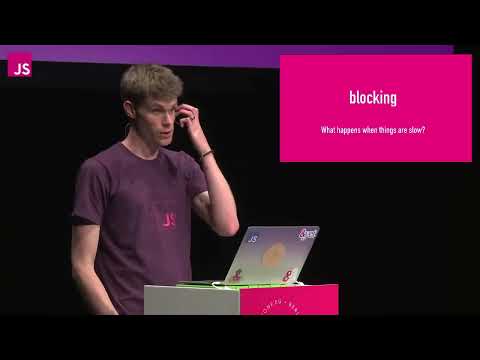
Jake Archibald's JSConf.Asia 2018 talk "In the Loop" explains the browser event loop, covering tasks, microtasks, requestAnimationFrame, and how rendering interleaves with JavaScript. It uses visual walkthroughs to show why code runs in surprising orders and why setTimeout fixes are unreliable.
HN treats it as the best primer on the event loop, praising its entertaining, easy-to-grasp visual explanations.
 49:55
How Python was Shaped by leaky Internals, Armin Ronacher, Flask framework
Видео с мероприятий {speach!
 26:53
What the heck is the event loop anyway? | Philip Roberts | JSConf EU
JSConf
 36:45
Rich Harris - Rethinking reactivity
You Gotta Love Frontend
 1:12:27
CppCon 2015: Andrei Alexandrescu “std::allocator...”
CppCon
 1:02:42
Preventing the Collapse of Civilization / Jonathan Blow (Thekla, Inc)
DevGAMM
 42:15
"Performance Matters" by Emery Berger
Strange Loop Conference
 1:42:09
Crockford on JavaScript - Volume 1: The Early Years
YUI Library
 37:37
RailsConf 2016 - Turbolinks 5: I Can’t Believe It’s Not Native! by Sam Stephenson
Confreaks
9 comments from Hacker News
Be sure to understand the event loop. Javascript as an asynchronous language often comes back to bite beginners. Here are two great talks to help you: [VIDEO] [LINK] Your life will be easier if you learn to use Chrome Dev tools (or the Firefox equivalent) early. In the beginning, you don't have to worry about browser compatibility - embrace modern JS (ES6+)!
Jake Archibald talking about the javascript event loop and actually making it both entertaining and easily grokable! [VIDEO]
Jake Archibald's "In the Loop", Visual explanation of how the javascript event loop works! Awesome video for every javascript developer. [VIDEO]
Just rewatched this talk on Monday from last year where Safari was called out for the rAF behavior that was fixed here. Cool to see this change. [VIDEO]
The best primer for the event loop I have found is here: [VIDEO] The speaker (Jake Archibald) has that rare ability to be both likeable and relatable, while also being incredibly knowledgeable and enthusiastic. I wish a lot more talks were like this!
I've been struggling with wrapping my head around asynchronous programming with callbacks, promises and async/await in JS, however I think it's finally clicking after watching these YouTube videos and creating a document where I explain these concepts as if I'm teaching them to someone else: * Philip Roberts's What the heck is the event loop anyway? - [LINK] * The Story of Asynchronous JavaScript - [LINK] * JavaScript Callbacks, Promises, and Async / Await Explained - [LINK] * Async Javascript Tutorial For Beginners (Callbacks, Promises, Async Await). - [LINK] * Jake Archibald: In The Loop - setTimeout, micro tasks, requestAnimationFrame, requestIdleCallback, - [VIDEO] Edit... I've been rewatching these videos, reading the MDN docs, the Eloquent JavaScript book, javascript.info, blogs about the subject, etc. This further proves you shouldn't limit yourself to a single resource, and instead fill up the laguna with water from different sources if you will.
Coming from C and having used thread and being totally ignorant to javascript, this article really helped me grasp async in js by clearing away implicit misconceptions I held : [LINK] And also that talk on the event loop : [VIDEO]
I think there's never been a better time to be a JS developer. JS is now everywhere. It runs on browsers, it runs on servers, it runs on mobile devices. You can use it as a scripting language if you really hate python and ruby. You can compile it to webassembly. There's game engines that use JS. Typescript is great as JS projects grow larger and more complex (if you can get over the fact that reading complex types is stupid) So the more and more JS devs are coming in, the more we need JS experts who really understand how stuff works at lower levels. Like for example the browser event loop - [VIDEO] Being an expert that deeply understands a tech stack will never go out of style
> It basically flickers between tasks very rapidly to simulate concurrency. That’s usually used a description of preemptive multitasking, like what you get running a modern OS on a single core (on multiple cores it’s also this but on each core). Every once in a small while, the current task is made to inhale chloroform, another task is chosen to wake and takes its place. Pro: you can’t hang any given task from a single thread; con: shared memory is very difficult to impossible, as you never know when you’ll be interrupted. Browser JavaScript and UI interactions instead use cooperative multitasking, which you’ll also find in classic Mac OS, 16-bit Windows, basically every embedded system ever, and languages like Python and Lua. A task has to explicitly call out to the scheduler to hand off execution resources to the next one. Pro: as task switching only happens at clearly visible points, many of the horrors of shared memory are diminished; con: you can and will hang the UI (or other outside-world interactions) if you accidentally write an infinite loop or just do too much CPU-bound work without yielding (as any developer using one of the aforementioned systems knows). For how this works in the browser environment specifically, see Jake Archbald’s superb talk[1]. [1] [VIDEO]