MINIX 3: a Modular, Self-Healing POSIX-compatible Operating System
FOSDEM4 HN recommenders · 2013–2023
90K views · talk · evergreen · Uploaded 2010-02-14
Andrew Tanenbaum's FOSDEM 2010 talk on MINIX 3, a microkernel OS built for high reliability and security. It shows how the system detects and recovers from device driver crashes, and addresses microkernel performance concerns.
HN points to it as an accessible explanation of microkernel isolation and fault-tolerant design, and as Tanenbaum's answer to performance objections.
 42:03
The Soul of Erlang and Elixir • Sasa Juric • GOTO 2019
GOTO Conferences
 47:18
The Tragedy of systemd
linux.conf.au
 40:20
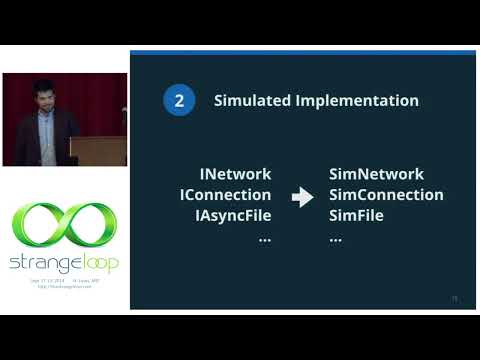
"Testing Distributed Systems w/ Deterministic Simulation" by Will Wilson
Strange Loop Conference
 1:48:55
The Thirty Million Line Problem
Molly Rocket
 1:03:51
VCF East: Ken Thompson interviewed by Brian Kernighan
Vintage Computer Federation
 49:15
Erlang Factory 2014 - That's 'Billion' with a 'B': Scaling to the Next Level at WhatsApp
Erlang Solutions
 1:04:04
LISA11 - Fork Yeah! The Rise and Development of illumos
USENIX
 47:43
"Turning the database inside out with Apache Samza" by Martin Kleppmann
Strange Loop Conference
6 comments from Hacker News
It's also for security. If you find a security vulnerability in e.g. the sound driver, you're not going to get root access. Andrew Tanenbaum explains it well: [VIDEO]
Andrew Tanenbaum presenting on Minix 3's architecture: [VIDEO] . Regardless of one's opinions on microkernels vs. monolithic kernels, it's a very interesting but accessible talk for those interested in lower-level systems and fault-tolerant architectures.
Here's Andy Tannenbaum's response to the performance issues of microkernels: [VIDEO] (should start at about 47:15)
Writing OS's is hard and there are no shortcuts. You should take a look at microkernels and the work Andrew Tanenbaum did with Minix 3 [1] and his modular design as this is the sort of direction you're probably looking for with customisable OS's. [1] [VIDEO]
(2015) Previously: [LINK] And see [1], my note about this talk being more or less the same as the 2010 Minix talk at FOSDEM[2]. If you saw that one, or any other talk by Tanenbaum of that period, I'll spoil it for you: there's nothing substantially different in this talk. 1. [LINK] 2. [VIDEO]
Here's you some examples to learn from. Most are old enough that patents have expired: Why Do Computers Stop and What Can Be Done About It? (1985) [LINK] Their NonStop Architecture [LINK] QNX's systems are ultra-reliable, too [LINK] OpenVMS clusters' uptime was years to decades & mixed CPU ISA's [LINK] Systems that run forever and self-heal (Armstrong) [LINK] Microreboots [LINK] Minix 3: Microkernel-based, self-healing, POSIX OS [VIDEO]