IBM Selectric Typewriter & its digital to analogue converter
engineerguy4 HN recommenders · 2016–2025
1.1M views · explainer · evergreen · Uploaded 2010-11-07
Bill Hammack of engineerguy uses slow motion video to show how the IBM Selectric typewriter works. He focuses on its fully mechanical digital-to-analog converter, which turns key presses into rotation of the type ball.
HN commenters recommend it whenever the Selectric comes up, as a short, excellent explanation of its internals.
 28:03
AT&T Archives: Similiarities of Wave Behavior (Bonus Edition)
AT&T Tech Channel
 9:31
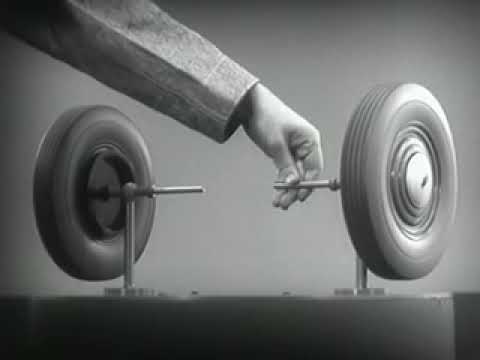
Around The Corner - How Differential Steering Works (1937)
US Auto Industry
 1:24:13
Micro Men - 720p (2009)
gimpymoo
 1:21:22
Light Years Ahead | The 1969 Apollo Guidance Computer
TNMoC
 32:35
Detergent packs are kinda wishy-washy (Dishwashers Explained)
Technology Connections
 41:53
Mechanical Computer (All Parts) - Basic Mechanisms In Fire Control Computers
Excelsior10000
 56:09
Project Code Rush - The Beginnings of Netscape / Mozilla Documentary
The Documentary Network
 32:56
Bret Victor The Future of Programming
Joey Reid
8 comments from Hacker News
You may enjoy Bill Hammack's video "IBM Selectric Typewriter & its digital to analogue converter" [VIDEO]
As in, were they fast enough to be used with other layouts? Yeah, but this was back when letters were dictated- secretaries didn't go switching to dvorak. Any typewriter could technically use any layout, since you'd just have to swap out the characters. The biggest advantage of the selectric was that you could swap out the ball to get different characters or fonts. The ability to get italics was a pretty big deal. Here's Bill Hammond talking about them: [VIDEO]
A distributed system will never be as intuitive as MS Word, which is basically the digitized version of stone tables, or papyrus, or whatever thousands of years old thing we are already familiar with. Or just remain a bit more strict and look at typewriters. Word is a typewriter. People look at typewriters and sort of understand them after pushing one-two buttons. Yes, there are hidden gems and details and a long road from mechanical typewriters to Word and laser printers (e.g. [VIDEO] ), but people are a lot more intuitive about these pieces of hardware and software, because they are simply updates on existing tech. Distributed systems is a new, and hitherto an explicitly unknown concept for many people. And with minikube you can set up k8s as easily as MS Office. (Or you can use Typhoon [LINK] .. ) And it's trivial to package up all this into a website, like Office 365 and GKE [LINK] . Or you can run it on your own PC with minikube and Virtualbox/KVM/qemu, and similarly you can install Office locally. But it does not make sense for one and it increasingly makes less for the other too.
One of the interesting things about the Selectric is that it contains a mechanical digital-to-analog converter .. a Whiffletree mechanism. [VIDEO]
You might enjoy these. IBM Selectric Typewriter & its digital to analogue converter [VIDEO] The Whiffletree: A mechanical digital-to-analog converter [LINK]
The Selectric is a fascinating machine. I highly recommend watching "IBM Selectric Typewriter & its digital to analogue converter"[0] by The Engineer Guy. [0] [VIDEO]
To deepen the wonder, I'd be interested to see the longevity per material (PLA/Nylon/metal/...). I'd expect a lot of trial and error to deal with shrinkage and the probably high precision needed by the Selectric. But this is a great repository, thanks a lot! P.S. excellent short video by Bill Hammack on the Selectric internals: [VIDEO]
Bill Hammack (engineerguy) has an excellent video on the IBM Selectric titled IBM Selectric Typewriter & its digital to analogue converter .[1] [1] [VIDEO]