Breakout Session Presented by Dan Robinson of Heap at PGConf Silicon Valley 2015
Citus Data4 HN recommenders · 2016–2020
14K views · talk · dated · Uploaded 2015-11-24
Dan Robinson, then CTO of Heap, explains how Heap runs its product analytics backend on PostgreSQL and CitusDB. It covers conversion funnels, retention and cohort queries across tens of billions of events and 50 TB of data, plus Postgres and Kafka together and the indexing strategy.
HN commenters point to it as a first-hand overview of Heap's Postgres/Citus architecture and its distinctive indexing approach.
 42:03
The Soul of Erlang and Elixir • Sasa Juric • GOTO 2019
GOTO Conferences
 19:09
A Better Default Colormap for Matplotlib | SciPy 2015 | Nathaniel Smith and Stéfan van der Walt
Enthought
 40:20
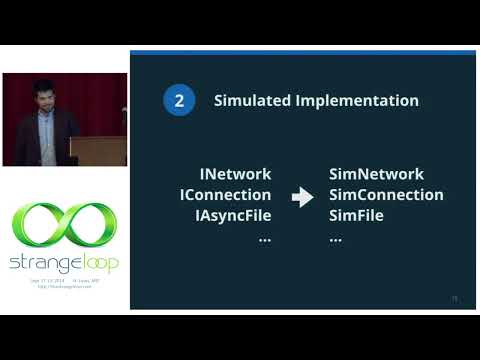
"Testing Distributed Systems w/ Deterministic Simulation" by Will Wilson
Strange Loop Conference
 31:44
The Value of Values with Rich Hickey
InfoQ
 58:51
DON'T PANIC — Hans Rosling showing the facts about population
Gapminder Foundation
 59:56
AWS re:Invent 2018: Amazon DynamoDB Deep Dive: Advanced Design Patterns for DynamoDB (DAT401)
Amazon Web Services
 49:15
Erlang Factory 2014 - That's 'Billion' with a 'B': Scaling to the Next Level at WhatsApp
Erlang Solutions
 47:43
"Turning the database inside out with Apache Samza" by Martin Kleppmann
Strange Loop Conference
8 comments from Hacker News
I was just watching this[0] excellent talk from one of the Heap Analytics engineers on their use of CitusDB + Postgres to do event processing. What use-case would TrailDB be the obvious, hands-down way to go (vs maybe Postgres + Citus)? [0]: [VIDEO]
If you haven't already seen it, Dan from Heap Analytics has a great talk about how they use Postgres and Citus. [VIDEO]
Keep in mind that Heap collects a huge amount of data and has a huge dataset. I like this[1] talk, it gives you an overview of their architecture. Great post though, thank you for sharing. [1] [VIDEO]
As of right now, our schema is literally: user_id | event_id | time | data where data is a JSONB blob that contains every other piece of information about an event. Currently, we get a row estimate of one for pretty much every query. We've been able to work around the lack of statistics by using a very specific indexing strategy (discussed about in a talk Dan gave[0]) that gives the planner very few options in terms of planning and additionally by turning off nested loop joins. We are planning on pulling out the most common properties that we store in the data column, which will give us proper statistics on all of those fields. I am currently experimenting with what new indexing strategies we will be able to use thanks to better statistics. [0] [VIDEO]
That get's into our indexing strategy which Dan talks about in this talk[0]. Currently our tables aren't completely insert only, so a BRIN index wouldn't work for us, as one row in the wrong place can cause a huge amount of extra reads. [0] [VIDEO]
Regarding a), a sharded postgresql (i.e. with citus data) can easily accomodate that workflow with just a tiny bit of extra overhead. Re c) this strongly depends on the usecase, I've seen companies use a) to avoid split-brain problems and having to manage two data pipelines to great success at similar scales. You might find [VIDEO] interesting.
You need a queue in front of your database irregardless of write latency. Otherwise you tie your availability to database availability as downtime (even for upgrades) is often unavoidable and network problems are common. Dan gave a pretty good talk about the high-level details of how/why postgres a couple of years back: [VIDEO] . One reason of why pg is that SQL is really powerful for building complex queries.
I'm curious as to how you plan to scale PostHog to larger users. As the person who scaled Heap, here is my honest opinion of this. I think there is going to be a huge challenge ahead in scaling query performance. This was perpetually a challenge at Heap and was for a long time the main limitation on Heap's growth. The challenge was tough enough for Heap and PostHog is going to be at a huge disadvantage due to the lack of multi-tenancy. When you use Heap, your data is stored across Heap's entire cluster of machines. When you run a query, that query is ran simultaneously against every single machine in Heap's cluster. Even though your data may be taking up something like .1% of the total disk space, when you run a query, 100% of the disk throughput of Heap's cluster will go to processing your query. It's not an overstatement to say this alone results in a >50x improvement to query performance. I honestly think Heap wouldn't be possible without multi-tenancy. It's hard enough as is to get queries that process multiple terabytes of data to return in seconds when you have a fleet of dozens of i3s available. I'm not sure how you would do that with a fleet a tiny fraction of that size. If you're curious about Heap's infrastructure, Heap's CTO, Dan Robinson, has given a number of talks on how it works[0][1]. That's not to say that PostHog won't work for anyone. I previously tried (and failed) to start a company based on optimizing people's Postgres instances. One of the big takeaways